Showing posts with label Birds and other Wildlife. Show all posts

Wednesday, May 22, 2013

Wandering warblers by the waves

Northern Parula (lower left) faces the waves
It's spring...sort of...in Duluth. Birds are migrating through...slowly. Living here on Park Point, we see a lot of migrating birds, especially when it's foggy and windy out. Then they pause for the duration to find refuge and a little bit of food. Birders call it a "fallout."

Here's a good local blog entry on the fallout frenzy in Duluth. One birder found 24 different species of warblers on Park Point in just a few hours this weekend.

For the last few days, there have been dozens and dozens of warblers visiting our backyard and the sandy Park Point beach. Out on the beach, they are hanging out on the little lines of debris washed up by the waves. They must be finding something to eat there, maybe little dead insects.

American Redstart on the sand
These birds are tired, hungry and cold. If you're walking your dog on the beach, keep the dog on the leash so they don't chase these birds to exhaustion.

Northern Parula, up close
Northeastern Minnesota, with its deep forests and its clean lakes and rivers, is warbler paradise. These little flits of life fill our habitats with their songs and color. It's an honor to help them along their way.

Sunday, May 5, 2013

We found spring on the Western Waterfront Trail

Sure it's May 5th already. But when I told Sally I wanted to go for a hike this Sunday afternoon, her question was obvious, "Where?" As in, "Are you crazy, everything is snowy, muddy or crowded." 

Duluth's Western Waterfront Trail is a reliable destination for an early spring hike, even when early spring comes in early May like this year. The wide gravel trail dries out early. Migrating waterfowl fill both inviting stretches of open water and the various grassy mudflats around the edges. 

As I recommend in my book Hiking the North Shore, we headed for the obscure eastern trailhead of the Western Waterfront Trail, on 63rd Ave. West. From there you can hike three miles along Duluth's upper St. Louis River estuary. Despite the sunny weather, we had the trail nearly to ourselves. The poodle was stuck on the leash, and had a great time sniffing up all the smells coming out of the thawing ground.


The trail did sustain some damage in last year's June flood, and things are still stabilizing. At one place, a stream had chosen its own crossing about fifty feet away from the old bridge and one hundred feet away from the new culvert. But it's still in excellent shape overall.

So while you're waiting for the Superior Hiking Trail to emerge from winter, and if you don't want to deal with the crowds on the Duluth Lakewalk or the paved paths of Gooseberry Falls, head for the Western Waterfront Trail.

Warbler Walks on the Western Waterfront Trail
If it's a Tuesday in May, head for the Western Waterfront Trail at 6:30 AM for Duluth Audubon Society's annual spring warbler walks. Bring your binoculars!

Monday, September 17, 2012

North Shore fall colors on Twitter: Let's have a hashtag!

Twitter is this huge and powerful online media tool. For a company that has a bird for its logo and a bird song for its main product (tweets), you'd think there might be a lot of nature stuff on the site. There isn't. The most popular topics, the "trending" topics, are celebrities, sports and political gaffes, not bird migration or wildflower blooms. 

Let's use Twitter to follow the amazing show of North Shore fall colors. To do that, we need a "hashtag". I'm suggesting this one: #fallcolors.

I do a lot of tweeting. Here's my Twitter page. Sign up to follow me on Twitter and I'll keep you up to date with what's happening on the North Shore.


Here's, briefly, how Twitter works:

1) Individuals like you or me create an account and a username. 
2) You can pick anyone you want to "follow", and their tweets show up on your timeline as they write them. It's sort of like the old ticker tapes that reported stock prices, bits of information coming in one after another.
3) As people write tweets, they can include a word or short phrase with the character "#" before it. That character used to be known as the number sign, and now it's a "hash tag". 
 4) Then, other people interested in the same word or phrase can search for or click on that word or phrase and find every other tweet with that word or phrase in it.

North Shore folks following the fall colors: Let's share what we're learning about fall colors by using "#fallcolors". Everytime you see something happening with those maples or tamaracks, send out a tweet or a link, and add "#fallcolors" to the tweet.

See what's up with the #fallcolors hashtag right now by clicking on this link.  

Together, we can do this!

Monday, March 19, 2012

Why I live in Minnesota, not in Germany

Seventeen long years ago, Sally and I lived in Heidelberg, Germany for about seven months.  Germans love to hike, and we had a network trails heading up into the hills above the town. One weekend, we sought a little more adventure, so we headed out of town for the Wolfsschlucht

Germany has so many people and a culture passed down for centuries. Part of that culture includes naming nearly every natural feature that can be distinguished from the surroundings. For example, most hiking trail maps will mark where you can find important trees, and nearly every cliff has a name passed down through the generations.

Wolfsschlucht translates as "wolf's gorge." No doubt a few centuries ago some villager encountered a wolf here, and the legend lives down to today. It sounded like a wild place, maybe steep enough and remote enough that it still could feel wild, wild enough to have been the last refuge of a besieged European wolf.

To reach the Wolfsschlucht, we took the train about ten miles up the Neckar River, then got off at Zwingenberg. We followed a stone path that traversed up through old walls and then cut away from the Neckar into a steep side valley...the gorge.

I couldn't find any photos from that hike in our scrap book, but here's one I found online that captures the spirit of the hike...in more ways than one:

Note the sturdy stone bridge...and the large crowd of people. The only thing better than hiking for a German is to hike with a large group of people.

A sign at the trailhead (also found this one online) warned just how dangerous the Wolffschlucht was, only for practiced hikers, with danger of sliding and being hit by rocks on the unsecured path. No danger, however, of being eaten by wolves.

It was a great day and an adventure that combined culture and nature in a way that almost never happens in the US. 

So this weekend, Sally and I headed out for a hike here in Duluth. No streetcars here, so we drove, with the poodle along for the ride. We went to the Willard Munger Trail, since we guessed it would be dry and sunny. One of the scenic highlights was passing through a steep railroad cut, a gorge if you will. And wouldn't you know it, on the far side of the gorge, we found wolf scat, four or five piles along the edge of the paved trail.


It was a real wolf's gorge, our own actual Wolfsschlucht

In Germany, you find little pockets of wildness surrounded by fields and cities and highways. In northern Minnesota, you find pockets of settlement and trails surrounded by wildness. In Germany, wolves are only found in the most remote and broad forests along the eastern border. Here, wolves are almost everywhere.

I like it this way better.

Friday, December 23, 2011

"Not even eaten at all."

This bit of news from the Duluth News Tribune on February 10, 1898 sure was a relief to read. We're headed up to Ely over the holidays and would have hated to come across Mr. Cameron's remains.

Saturday, September 17, 2011

Big lake, bigger bird: Park Point Pelican

I was pretty excited last night when I heard my son say, "There's a HUGE bird on the beach." First, that's about five more words than I typically get out of him. And second because he was noticing something natural and not something digital. And to my amazement, he kept talking. "It's a swan or something."

Of course I had to see for myself, so I headed out for the door with my camera. I didn't even have to leave the kitchen before I saw it for myself, this mass of white floating as if it were styrofoam over the lake. I've only seen this big bird in Duluth 2 or 3 times before, but I knew right away it was a pelican. The White Pelican, Pelecanus erythrorhynchos.  

But I continued down to the beach. Pelicans are here in Duluth only as a "casual straggler." Funny that out in the lake behind it was another straggler, the Dutch-flagged saltie Kwintebank.

This morning I caught another glimpse of the pelican, still out the kitchen window. I headed out again, this time with the dog, and managed to get closer to the bird as it swam along the beach. Zooming in, I managed not so shoddy a picture.

We kept on walking down the beach, dog and I. When I turned around, the big bird was nowhere to be seen on the lake. Within a minute or two, I realized why: it was up on the beach. So dog and I carefully made our way high up on the beach near the dunes and walked respectfully past the bird. The pelican was quiet and moved just slowly, keeping one eye on me and the poodle at all times.

The pelican, up close, is more beautiful and more big than I ever imagined. Every twist and turn of the neck is gorgeous to watch, and the long beak. When I got back home, I read in my bird guide that pelican's wing span can be up to 9 1/2 feet...WOW. Back in our living room, I showed my son how that wing span would reach from one side of the room to the other. 


Thanks, pelican, for visiting Lake Superior and giving us all a little thrill.


Thursday, June 23, 2011

Lady's slippers and Larry Weber at Jay Cooke

Heavy rains this week have returned the North Shore rivers to flood stage. Rains also damaged the road construction underway near Split Rock Lighthouse, slowing the traffic there. This is the weekend to stay closer to Duluth and explore the seasonal wonders of Jay Cooke State Park.

Showy Lady's Slipper, from www.maine.gov
Lady's slippers near and far
Wildflower fans come to Jay Cooke in early summer for the displays of lady's slippers. This week, there are yellow and showy lady's slippers blooming in the park, including some that are found right near the park office. Hike #1 from my book Hiking the North Shore, the 3.6 mile Silver Creek Trail, goes right past a huge stand of yellow lady's slipper. Stop at the brand-new park office for directions to the park's fabulous orchids.

The Swinging Bridge over a raging St. Louis River, 2008
The St. Louis River is running high after heavy rains, and should be thundering underneath the park's iconic Swinging Bridge by this weekend. But the river won't be the only noise there: park naturalist Kristine Hiller says that gray tree frogs are hanging out on the bridge stone pilings and calling.

Learn to fish, camp and birdwatch
Three interesting...and free...programs are on tap for this weekend in the park: on Friday, join the "I Can Fish" program from 1:00 to 3:00. On Sunday, there's "Camping 101" , also from 1:00 to 3:0.

Larry Weber
Early-risers, birdwatchers and nature lovers are in for a special treat. At 7:00 am Sunday morning, meet renown local naturalist Larry Weber at the campground bathhouse for a bird song walk. No binoculars needed, just listening. 

How to get there
The park is located in Carlton, MN. If you're coming from the Twin Cities, take exit 235 off Interstate 35 and head through the towns of Carlton and Thompson on Hwy 210 to the park. From Duluth, take exit 239 and follow the signs to Carlton and the park.

Wednesday, June 8, 2011

Four random facts about Bunchberry


The bunchberry are blooming along the North Shore. With their simple, bold flowers and symmetrical leaves, they are one of the most common and easiest to identify of all flowers.

Like many wildflowers, this one has lots of factoids concerning its name, its ecology and even its anatomy. You can impress your hiking companions with just one of these four random facts. By the time you get all four out, they'll think you're a genius.

Random fact #1: The name bunchberry refers to the tight "bunch" of orange-colored berries that ripen later in summer. 

Random fact #2: A common local name for the flower is "Canada dogwood." In fact, that's a literal translation of the scientific name Cornus canadensis


Random Fact #3: The beautiful white "petals" aren't actually petals. Instead, they are modified leaves that surround and draw attention to the actual flowers, which are very small and greenish yellow. Each one of those little flowers could ripen into one of the orange berries. 

Random Fact #4: The berries are popular with veeries and vireos. 


Any questions?

Monday, May 9, 2011

Sparky's "Daffy Ducks"


Leave it to Mark "Sparky" Stensaas to find great footage and fine stories about North Shore natural history. And thank goodness for telescopic lenses. 

Sparky caught some great action this spring. Diving ducks have goofy, elaborate courtship rituals, but the shows are for the females, not the birdwatcher. Generally the show is so far away from shore, the average person never sees them. 

The video shows hooded mergansers doing a bizarre head pump, common goldeneyes doing a ballerina-like neck stretch, and three frenetic male common mergansers trying to out-goofy each other in the presence of one disinterested female.

Thanks for catching the show, Sparky!

Monday, May 2, 2011

Searching for Spring in West Duluth

If you really need a spring walk and you'd like to see some real spring birds, maybe some real spring flowers, and open water, head for Duluth's Western Waterfront Trail. It's one of my favorite spring walks, even when it's 40 degrees and snowing in May like it was yesterday.

The Western Waterfront Trail runs for over three miles along the shore of the St. Louis River, connecting the neighborhoods of West Duluth and Riverside. It's a wide trail, built strong enough for biking on its hard gravel surface. 

Bring your good binoculars. The St. Louis River here is a web of channels and backwaters, all attracting different waterfowl and migrating mystery birds. Yesterday I saw lesser scaup, hooded mergansers, and ringneck ducks.

I like to start the trail at its eastern end, off 63rd Avenue West. Depending on your freeway exit, you can get to 63rd Avenue West off of Grand Ave. or off of Central Avenue and Raleigh St. From 63rd and Raleigh, it's another 0.5 miles to, basically, the end of the road. Look for the trail as it crosses the Avenue, and park near the trail. For more detailed directions and a trail map, pick up a copy of my new book, Hiking the North Shore (see blog sidebar to order).

Not much spring to report, however, besides the birds on the river. 
The wild leeks had their onion-smelly leaves up, and the buds were swelling on the willow trees. Kingsbury Creek was running high under the metal bridge. The trail is drier than most woodland trails are now and would make for a great hike for a family or sweeties holding hands.

Tuesday, April 5, 2011

Amazing Lake Superior bird story

If you are a nature geek like me and if you love Lake Superior like I do, there isn't a better story to hear than this one from Sparky Stensaas and Lake Superior Magazine.

It's an amazing combination of birdwatching and shipping, of citizen science and Lake Superior geography. From the discovery made by a Duluth remodeler and his elderly client to the pages of Audubon magazine. The crux of it is Captain J.P. "Perk" Perkins, an avid birdwatcher and ship captain who set up a miniature forest on the deck of his laker and monitored the birds that found refuge there as they crossed Lake Superior. Along the way, he discovers unknown migration flyways and rewrites Midwest ornithology.

Sparky is a great naturalist and photographer, with an ear for a great story. I had heard parts of this discovery in the past, and am so glad Sparky was able to put all the pieces together.

Friday, December 31, 2010

In the wolf wilderness at Gooseberry


Sally and I went for a lovely ski this week up at Gooseberry Falls State Park. We skied nine kilometers of freshly-groomed ski trail through the park's backcountry. And had quite a thrill along the way, reconnecting us with wild places and wild creatures.

Gooseberry has three main areas of ski trails. On the lake side of Highway 61 is a long loop through the campground and by the river. On the inland side of Highway 61, there's a large and complex network of trails on the east side of the river. On the west side of the river, there is essentially one big loop. That last loop gave the two of us quite a wilderness thrill, despite being in the middle of one of the North Shore's most popular parks. 

We started at about 2:00 in the afternoon and worked our way up the eastern side of the trail system, to the high hill with its view off to the wild north. There's a trail shelter up top, surrounded by open meadow now filling in with big, full white spruce trees. It feels like the glades of the Rocky Mountains. 


By the time we crossed the Gooseberry River at the Fifth Falls bridge, it was after 3:00 and the sun was definitely headed for the horizon. As we headed slowly uphill around the big loop, the wolf signs began to show. Deer fur clung to the snow. Two leg bones stuck out of the groomed track. 

It's a long climb to the top, emerging into open country with a view of Lake Superior. We were headed into the wind. The only tracks on the groomed ski trail were wolf. We skied into a slight headwind.The brush around us could hide a deer or a wolf.


Sally was ahead, but she stopped. When I caught up with her, I found her visibly shaken. "I smell something," she said. "Stay with me." 


The brain knows that wolves don't attack people. The heart knows otherwise. 


We came to the big downhill part of the loop; I led the way.


As I picked up speed on the downhill, I realized that a very clever wolf could stick right on this treacherous bit of hill and, were it to like humans, wait for a skier who might fall here. Again, the brain says that's crazy. But as dusk approaches and signs of an active predator surround, the heart speaks louder. The wolf scat laid neatly into the ski track was no comfort.


We skied out to finish the loop, making noise as if we were in grizzly country out west.  Wolf scat, tracks and pee were everywhere. A deer carcass lay half-buried in the snow just off the trail. We made it to the car as the sun dropped below the trees. Relieved.


To travel off into the wilderness of wolves, to feel just that little bit as if we might be a predator's prey, reconnected us with nature and adventure like no simple ski outing could.

Tuesday, November 9, 2010

Canal Park: Gorgeous and free

Great news, Duluth residents and fans of the REAL North Shore. You can come back to Canal Park now. Parking is free and plentiful. Park at a meter and pay nothing; it's after October 15th. 

The gulls have left the Marine Museum and are hanging dolefully on the South Pier. Virtually no need to fear gull droppings in your hair. The gates on the South Pier have been closed, but the North Pier, on the busy Canal Park side of the Canal, is still open for all.


And the late fall light is gorgeous, turning everything blue and aglow, like the Swedish flag.  

Get down here while it's gorgeous, before November storms and January ice turn it gray and treacherous. 

Monday, October 25, 2010

Snow buntings

Driving from Ely to the North Shore yesterday, I was stunned and thrilled by the flocks of snow buntings rising from the road as we passed. Photos were simply impossible, since we were going at least 60 mph and the birds popped up without warning. But the beauty of the flock in flight, the flashing of dozens of white wings, called out for something, somehow, to capture it.

Maybe some snow bunting simile?

Half-burnt aspen leaves, caught in the updraft, rise and dance from the burn pile.

Snowflakes scatter from the road, up and out and away, only there is no snowstorm.

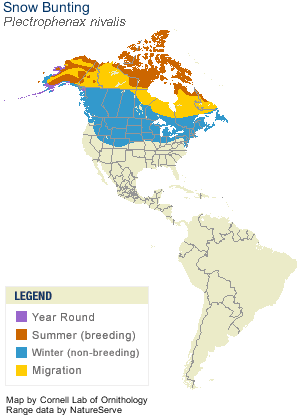
Snow buntings, according to the Cornell Lab of Ornithology,  are migratory birds for whom Minnesota is "south." They nest in the high Arctic. There, the males arrive weeks ahead of the females, in the long long sunrise of the Arctic spring. Prime nesting sites are deep in rock crevices, which the males line with their own feathers. The birds we see here are scrubby brown and white, with dramatic flashes of bright white when they fly. The males rub off that winter plumage to line their nests and to reveal their summer plumage of all black and all white.

The best photo of snow buntings in flight I could find online comes from the website of Donald and Lillian Stokes.  Check it out!

Tuesday, April 27, 2010

Looking for Old Sam Peabody


Walking through Duluth's Canal Park this morning, on my way to a meeting at the Amazing Grace bakery, I heard a very familiar song through the din of traffic and construction. Like in the old game show "Name That Tune," I could name that tune in three notes.

"Old Sam Peabody Peabody Peabody."

(or was it "Oh My Canada Canada Canada?"

I went three or four summers in the BWCA hearing the song of the white-throated sparrow but never ever seeing the bird. They hide so well in the thick shrubs next to the lakes. So I listened hard and the next time the sparrow called I walked in the direction of the sound. I did that three or four times until I reached a little corner of rocks and spruce trees in the corner of the parking lot, I was surprised to pick out the bird right away, perched on a short mugo pine. Like in the BWCA, these shrubs were near water, the famous Canal Park fish fountain.

The video above captures another whitethroat on another pine tree. I love how the video captures the bird listening, looking around, hearing other sparrows sing, then launching into its own song. Actually, it's just like our psycho poodle, who goes out on the porch and does the same sequence. Listen, look around, bark, listen, bark.

Poor little lonesome white-throated sparrow was looking for love in all the wrong places. I hope he's moved on to some fitting shoreline or outcrop deep in the North Woods. But I'm glad I found him when and where I did.

Sunday, March 7, 2010

Deer Abby: Advice for driving Hwy 61

It's March and the deer are all over Highway 61, making ravens and eagles happy and drivers nervous.

They say there are two kinds of North Shore drivers: those that have hit a deer, and those that haven't...yet. I still fall into the second category. But that's only a matter of my own dumb luck. My turn will come.

I'm tempting fate here, but here's what I've learned so far in my stellar no-deer stretch of luck:


  1. If you keep it under 55 at night, you'll have much more reaction time should Bambi pop out from behind a birch tree.
  2. Be especially observant at dawn and dusk . I see a lot more deer and they are moving more at those times. They call this behavior "crepuscular," which sounds like "creepy" and "muscular." Which is what deer are at night.
  3. Watch for flashes. If an oncoming car flashes highbeams at you, it might be a warning that there are deer ahead. Check your own headlights and then keep your eyes out for deer in the next 10-15 seconds.

If you see a deer:
  1. Where there's one, there may be more. In winter, deer are more likely to move in herds. If one has crossed the road safely, there's a decent chance that a second will follow.Don't let that SECOND one be your FIRST.
  2. Honk your horn. Flash your highbeams for the oncoming traffic to warn them. No, gangsters won't track you down and kill you for a random gang initiation...that's urban myth.
  3. Don't swerve. Stay in your lane. Brake firmly but not so hard you lose control. I've had plenty of close calls and stayed in my lane as I braked ("broke?"). By the way, experts suggest that you DO swerve if you're headed for a moose. I have never seen a moose on Highway 61, but it does happen. A 1600-pound moose wins the battle with your car much more often than a 200-pound deer.
If you hit a deer, hope you have your hunting knife. I'm not kidding: a friend of mine took this advice from her father and was able to gut out and keep a deer another car had just hit.


Okay, now I've done it. I've jinxed myself. See you at the body shop.

Sunday, January 31, 2010

The deer have come down...early

When the snow on the North Shore ridges is deep and the snow right by the lakeshore is thin, deer move to the lakeshore to feed. It's normally in March that the deer really move to the lakeshore, when early spring sun has melted the snow off the south-facing slopes.

The great deer slaughter on the North Shore has already begun. With the weird rain/snow blends we've had, the snow inland is as deep as ever and the snow by the lake is almost absent. The deer have come down. Early.

Yesterday there were at least five fresh carcasses between Duluth and Grand Marais.

Personally, I don't mind the loss of deer. There are too many deer on the North Shore and not enough white pine or cedar trees. I'd rather have way fewer deer, so that the pine and cedar trees can grow again.

I just worry about the cars and their drivers...including myself!

Be careful out there!

Wednesday, October 21, 2009

Hey, waxwings! Come and get me!


In what has otherwise been a rather pale fall color season, the North Shore has one bright red color stand-out: the huge mounds of berries from the mountain-ash trees. Pictured above is one clump of berries right outside the Grand Portage National Monument headquarters. Driving from Grand Marais to Duluth through the grey rain yesterday, I couldn't help but see succulent red clumps all the way down the shore. And I'm red-green colorblind! These berries are R-E-D.

Mountain-ash berries are an invitation to riot. The invitation is directed right at flocks of waxwings. 30 or 40 waxwings will descend out of nowhere onto a mountain-ash tree and mow through the hundreds of berries, denuding a tree within an hour. They swallow the berries whole. No time to chew. Then they move on. It really is one of nature's great spectacles.

Thanks to YouTube, I can share a video of Bohemian Waxwings doing their thing:


Hey, waxwing flocks: Get up here! If I could post to a "berry condition" hotline for birds, I'd be posting this one all over.


FYI
There are two types of waxwings, Cedar Waxwing and Bohemian Waxwing. Local birders suggest that the Cedar Waxwings are here in the summer and the Bohemian Waxwings are here in the winter. Either type of bird has a feast awaiting it on the North Shore.

Come and get it!

Monday, October 12, 2009

The warbler on my grocery cart


Image from Alan Wilson, www.naturespicsonline.com

Yellow-rumped warblers have been all over the North Shore this fall. My mother and her friends keyed out the birds that were all over their bird feeder, even cross-checking three different field guides to puzzle out the winter plumage. I've seen these birds skittering through gravel parking lots in Grand Marais and mobbing fields of tansy in Hartley Nature Center, far from their nesting habitat of spruce trees. And yesterday there was even one on my grocery cart.

I saw it first in the quiet, rather neglected natural foods section of the Super One here in Duluth, just a block from the spruce-y sanctuary of Leif Erikson Park. The bird was calm, roosting up high. Young cashiers and baggers came in with a broom and a milk crate to try to trap it, but could not. It didn't flitter and panic like other birds might. Just stayed still up on the top of the shelves.

Next I saw it was in the dairy section. I called out its name, "Yellow-rumped," maybe just to impress the young store workers, but right then the bird came and landed right on the shiny plastic handle of my cart, next to the bananas. I felt honored.

Yellow-rumped Warbler, you have seen it all. You have been "lumped" by the ecologists from two species into one. You have been studied by the late great Robert MacArthur, who found just which part of the spruce tree you fed on, leaving other parts for other warbler species. They say you are "one of the most generalized and opportunistic of all our insectivorous birds."

But you hadn't seen the inside of a store. I hope you found your way out, back on your way to Tennessee or Florida, so you can come back next spring in full regalia.

Friday, September 11, 2009

The cormorant who thought it was a gull


The Duluth Ship Canal is a magnet for tourists. We live just a few blocks from the Canal and the Lift Bridge, so we're often on the piers walking our dog or our boys.

Typically the wall of the piers are lined with gulls, mostly Ring-billed Gulls with the occasional Herring Gull in the mix. Each of the lightposts also has a gull perched atop. For the last week or two, someone else has been hanging out on top of the lightposts of the south pier: a cormorant with identity issues.

Here it is up close, moments before it shat it my general direction. Cormorants, FYI, have projectile feces.


I can't help but put some thoughts in this bird's head:

"Yup, just me and my buds, hanging on the lightposts..."

"Am I the only one out here actually diving under that cold water for my food??"

"Hey, who wants to play 'Duck-Duck-Goose' again?"